

Global Sterile Packaging Market to Reach USD 94.8 Billion by 2036 Driven by Amcor, Berry Global, Sealed Air Growth
Sterile Packaging Market
Germany demand driven by medical devices, pharma quality standards & strict compliance, with sterile packaging growth led by precision and barrier reliability.
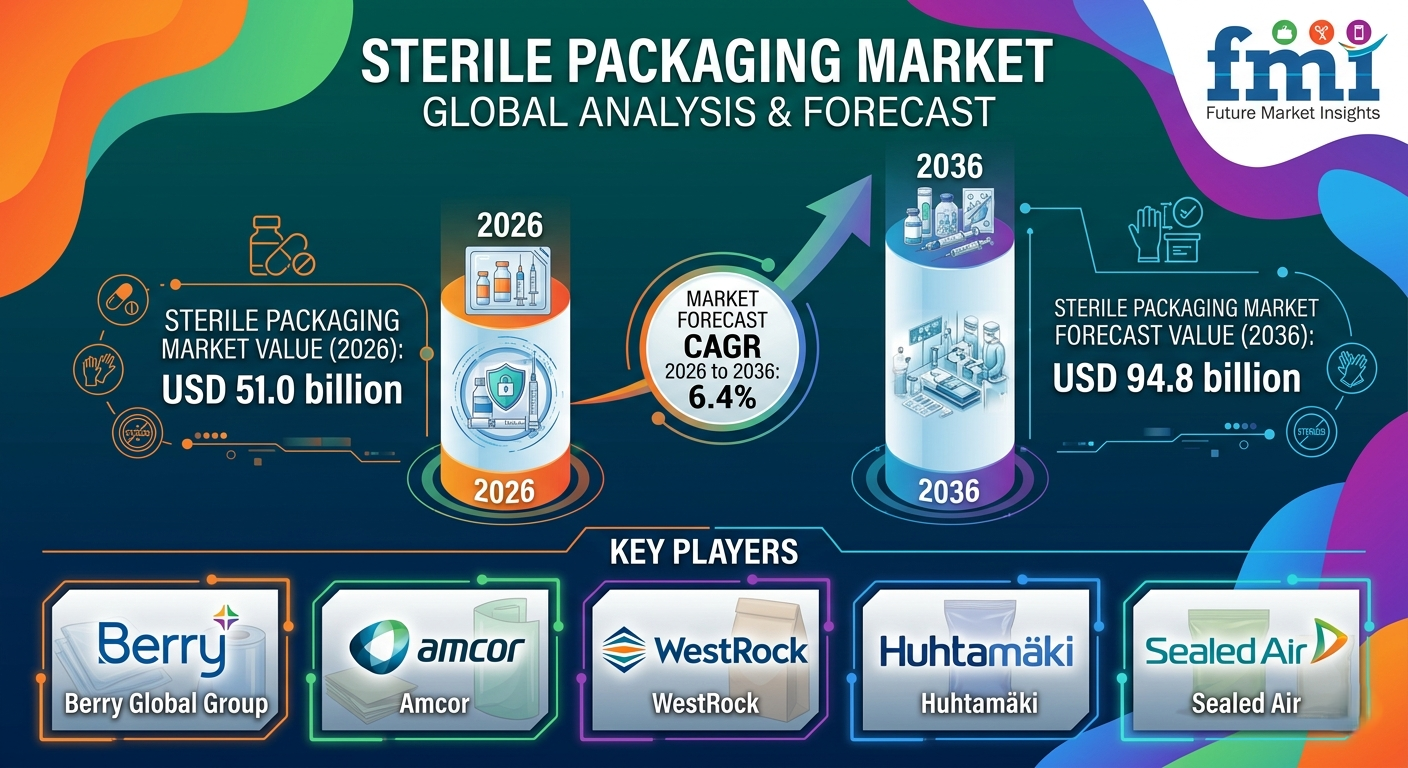
NEWARK, DE, UNITED STATES, April 1, 2026 /EINPresswire.com/ -- The global sterile packaging market is entering a sustained growth phase driven by regulatory compliance requirements, pharmaceutical production expansion, and increasing demand for contamination control across healthcare and food systems. The market is valued at USD 51.0 billion in 2026 and is forecast to reach USD 94.8 billion by 2036, registering a compound annual growth rate (CAGR) of 6.4% over the forecast period.
The growth reflects increasing global intolerance for contamination risk across pharmaceuticals, medical devices, diagnostics, and aseptic food systems, where packaging failure can lead to regulatory penalties, product recalls, and financial losses. Sterile packaging is increasingly treated as risk-control infrastructure rather than secondary packaging, making it a compliance-linked operational requirement across healthcare and life science industries.
Quick Stats: Sterile Packaging Market
• Sterile Packaging Market Value (2026): USD 51.0 billion
• Sterile Packaging Market Forecast Value (2036): USD 94.8 billion
• Forecast CAGR (2026–2036): 6.4%
• Leading Material Type: Plastic Films
• Fastest-Growing Countries: China, India, USA, Germany, Japan
• Key Companies: Berry Global Group, Amcor, WestRock, Huhtamäki, Sealed Air
Discover Growth Opportunities in the Market – Get Your Sample Report Now
https://www.futuremarketinsights.com/reports/sample/rep-gb-14608
Market Overview: Sterile Packaging Becoming Compliance Infrastructure
Demand expansion in sterile packaging is closely tied to regulatory intensity, product value protection, and operational risk reduction rather than discretionary packaging upgrades. Sterile barriers must maintain integrity across sterilization, transport, and storage cycles, making seal reliability, material consistency, and sterilization compatibility critical procurement factors.
Structural shifts in pharmaceutical manufacturing, biologics production, and global distribution networks continue to reinforce demand. Cross-border supply chains, contract manufacturing, and cold-chain logistics expose products to repeated handling and environmental variation, increasing the importance of mechanical strength, traceability, and tamper evidence in sterile packaging systems.
Automation in pharmaceutical and medical device packaging lines also favors materials with predictable sealing behavior and low defect tolerance, further driving adoption of high-performance sterile packaging substrates.
Why Demand for Sterile Packaging Is Growing Globally
Demand for sterile packaging is increasing due to rising requirements for product safety, contamination control, and extended shelf life across healthcare, pharmaceutical, and food industries. Sterile packaging protects medical devices, surgical instruments, diagnostic kits, and implantables from microbial contamination during storage and transportation, aligning with stringent regulatory frameworks across multiple regions.
Growth in biologics, vaccines, and advanced therapies is increasing the need for sterile packaging formats capable of maintaining product integrity under controlled environments. In the food and beverage sector, sterile packaging supports aseptic distribution models, extends shelf life, and reduces spoilage across long supply chains.
Advances in barrier materials, multi-layer films, and sterilization-compatible substrates are improving durability, performance, and compatibility with automated packaging lines. Expansion of global manufacturing, e-commerce distribution, and cold chain logistics further increases demand for robust sterile packaging systems capable of maintaining sterility under variable conditions.
Market Structure by Material Type
Sterile packaging demand is driven by infection prevention standards, regulatory compliance requirements, and expansion of pharmaceutical and medical device manufacturing. Packaging systems must maintain sterility throughout storage, transport, and handling while remaining compatible with sterilization methods such as gamma irradiation, ethylene oxide, and steam sterilization.
Largest Material Segment: Plastic Films
Plastic films account for the largest material share at 41.0%, reflecting their versatility, seal integrity, and compatibility with multiple sterilization technologies. Plastic films are widely used for blister packs, pouches, wraps, and sachets due to controlled permeability, high tensile strength, and consistent barrier performance. Their lightweight nature also supports logistics efficiency and reduced transportation costs.
Glass containers remain essential for applications requiring high chemical inertness and long-term stability, particularly for injectable pharmaceuticals and biologics. Metal cans are used selectively where mechanical protection and hermetic sealing are critical. Paper and paperboard materials support breathable sterile barrier systems, especially for surgical instruments and medical device trays.
Market Structure by Application
Pharmaceutical products represent the largest application segment at 48.0%, driven by high-volume production of sterile injectables, biologics, vaccines, and ophthalmic formulations. Regulatory scrutiny around drug sterility and patient safety reinforces demand for validated sterile packaging solutions that ensure integrity across global distribution networks.
Medical devices, surgical instruments, diagnostic kits, and implants represent significant secondary segments. These applications require packaging systems that protect against microbial ingress while allowing sterilization and aseptic presentation in clinical environments. Growth in minimally invasive procedures and diagnostic testing continues to support demand for single-use sterile packaging formats.
Key Market Dynamics
Global demand for sterile packaging continues to rise as pharmaceutical companies, medical device manufacturers, and healthcare providers adopt sterile packaging solutions to protect products from microbial contamination, ensure patient safety, and extend shelf life. Sterile packaging includes barrier films, pouches, rigid trays, and overwraps designed to maintain sterility through distribution, storage, and point of use.
Regulatory Requirements and Clinical Safety
Regulatory agencies impose strict sterile packaging standards and validation protocols to ensure integrity of barrier systems, sterility maintenance, and contamination prevention. Manufacturers integrate sterile packaging into quality management systems with documented sterilization methods, barrier performance testing, and traceability from production to patient use.
Healthcare providers and regulatory authorities emphasize packaging that supports aseptic presentation, tamper evidence, and compatibility with automated dispensing systems. Performance criteria include microbial barrier resistance, mechanical protection, and compatibility with sterilization technologies such as gamma irradiation or ethylene oxide.
Cost Pressures and Sustainability Considerations
Sterile packaging systems often involve advanced materials and multi-layer constructions that increase production costs compared to non-sterile packaging options. Material selection must balance barrier performance, mechanical strength, and seal integrity with sterilization compatibility.
Healthcare providers and regulators are increasingly emphasizing sustainability, prompting development of recyclable or reduced-material sterile packaging solutions. Long-term market growth depends on innovations that improve cost efficiency while maintaining stringent safety performance and regulatory compliance.
Global Demand Trends by Country
Demand for sterile packaging is increasing globally due to rising pharmaceutical production, growth of medical devices, and stricter regulatory requirements for contamination control.
Sterile Packaging Market CAGR by Country
• China: 7.8%
• India: 7.5%
• USA: 7.1%
• Germany: 6.3%
• Japan: 5.9%
China leads growth due to rapid expansion of pharmaceutical manufacturing, vaccine production, and medical device exports, supported by investment in cleanroom capacity and automated packaging lines. India’s growth is driven by injectable pharmaceuticals, biosimilars, and contract manufacturing services aligned with export-driven regulatory compliance.
The United States market is shaped by growth in biologics, cell and gene therapies, and complex medical devices requiring high-integrity sterile packaging systems. Germany shows steady growth due to strong medical device manufacturing and regulatory discipline, while Japan reflects stable demand driven by mature healthcare infrastructure and high product safety standards.
Competitive Landscape
The competitive landscape of the sterile packaging market is driven by companies capable of delivering validated sterile barrier systems, regulatory documentation, and global logistics support.
Key companies operating in the global sterile packaging market include:
• Berry Global Group
• Amcor
• WestRock
• Huhtamäki
• Sealed Air
Competitive differentiation depends on barrier quality, sterilization method compatibility, documentation support, and the ability to scale validated sterile packaging solutions across global manufacturing operations.
Why FMI: https://www.futuremarketinsights.com/why-fmi
Explore More Research Reports by FMI
Demand for PET Color Shrink Label in UK - https://www.futuremarketinsights.com/reports/united-kingdom-pet-color-shrink-label-market
Specialty Tin Cans Market - https://www.futuremarketinsights.com/reports/specialty-tin-cans-market
Rolling Papers Market - https://www.futuremarketinsights.com/reports/rolling-papers-market
Polyolefin for Medical Devices Market - https://www.futuremarketinsights.com/reports/polyolefin-for-medical-devices-market
Disposable Cutlery Market - https://www.futuremarketinsights.com/reports/disposable-cutlery-market
About Future Market Insights (FMI)
Future Market Insights, Inc. (FMI) is an ESOMAR-certified, ISO 9001:2015 market research and consulting organization, trusted by Fortune 500 clients and global enterprises. With operations in the U.S., UK, India, and Dubai, FMI provides data-backed insights and strategic intelligence across 30+ industries and 1200 markets worldwide.
Sudip Saha
Future Market Insights Inc.
+1 347-918-3531
rahul.singh@futuremarketinsights.com
Legal Disclaimer:
EIN Presswire provides this news content "as is" without warranty of any kind. We do not accept any responsibility or liability for the accuracy, content, images, videos, licenses, completeness, legality, or reliability of the information contained in this article. If you have any complaints or copyright issues related to this article, kindly contact the author above.
