

Why Execution Infrastructure Is Becoming Central to Modern Investment Models
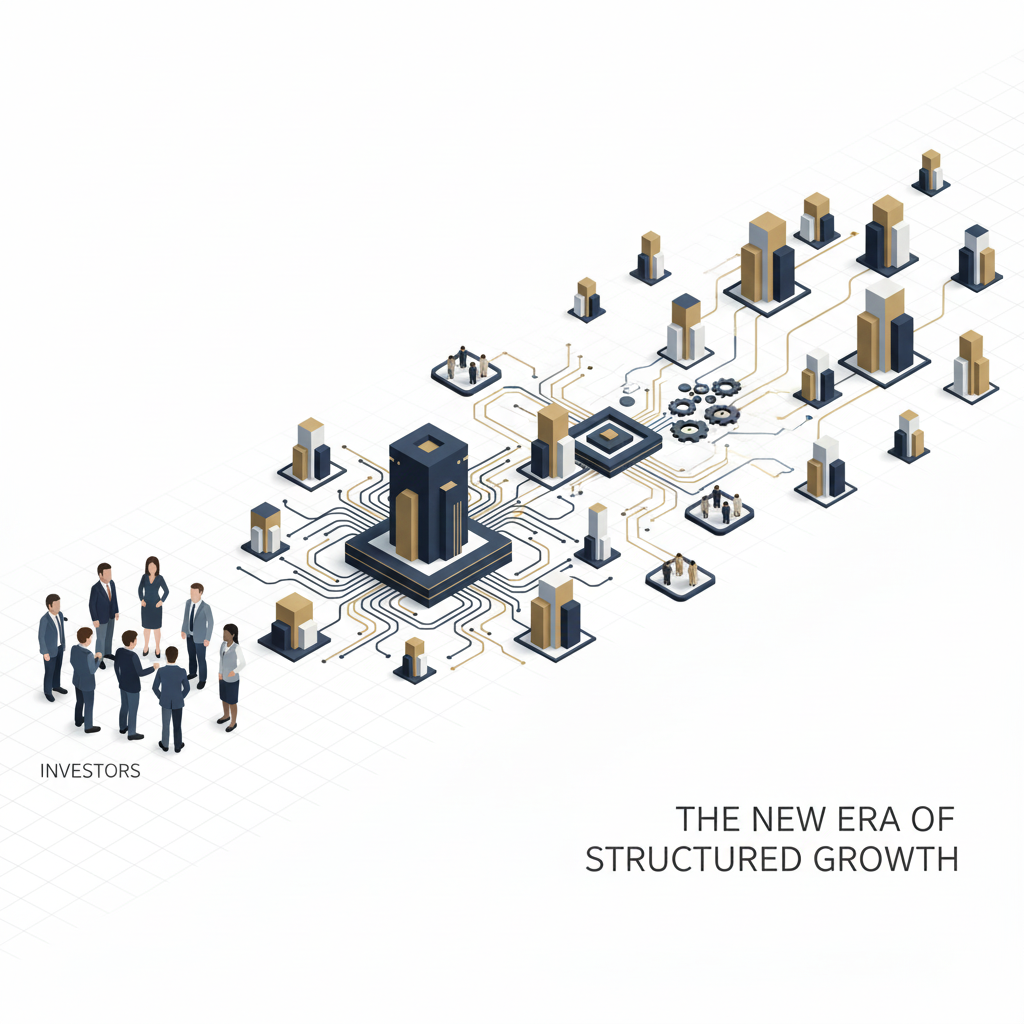
A modern execution-first growth model where centralised operations and expertise scale multiple companies in parallel, transforming execution into the primary asset rather than capital alone.

Elvijs Plugis, a London-based executive working with execution-led holding structures, notes that “execution systems — not capital — are increasingly becoming the primary asset in modern company building."
Why capital alone no longer creates scalable businesses—and how execution systems are reshaping modern investment models.
Today, that belief is quietly collapsing.
Across startups, SMEs, and even investor-backed companies, failure is no longer driven by a lack of capital. In fact, many businesses fail after funding arrives. The money lands — and momentum stalls, complexity explodes, and value quietly leaks away.
Investment isn’t the problem.
Execution is.
The Post-Investment Failure Pattern
Globally, the majority of companies that raise capital still fail to reach sustainable growth. Not because their products are weak, but because their organisations cannot absorb, deploy, and compound capital effectively.
Once funding arrives, founders are suddenly expected to manage:
* revenue systems
* marketing infrastructure
* operational scale
* hiring and leadership
* investor expectations
* governance and reporting
Most were never built for this. Capital accelerates pressure faster than capability.
The result is familiar to investors: fragmented agencies, misaligned consultants, money spent without systems, and boards overseeing companies that look busy but don’t actually move.
Capital flows in. Execution fractures.
Why Investors Are Frustrated — Quietly
Investors see this pattern repeatedly.
They back promising teams, deploy capital, secure board seats — and still lose control of outcomes. Once the cheque clears, value creation depends almost entirely on the founder’s ability to build an operating company from scratch, often for the first time.
Governance exists. Control does not.
This is why many investors increasingly focus on “teams” over ideas — yet still experience capital erosion. The real missing piece isn’t intelligence or effort. It’s institutional execution infrastructure.
Capital without an operating system is leverage without direction.
The Capability Gap No One Talks About
Building a scalable company requires expert-level capability across multiple functions:
* commercial strategy
* revenue architecture
* marketing systems
* operations and process
* financial discipline
* investor readiness
* brand and positioning
As a full internal team, this easily costs hundreds of thousands per year — far beyond what early-stage or underperforming companies can sustain.
Even worse, most founders cannot accurately assess whether the talent they hire is right, or how to integrate it into a coherent system. So capital is spent learning lessons investors already paid for elsewhere.
This is not a capital problem. It’s a capability gap.
A Shift Is Already Underway
Quietly, a different model is emerging — one that inverts the traditional investment sequence.
Instead of capital being handed to founders and hoping execution follows, newer structures reverse the order.
Execution comes first. Capital is deployed around what already works.
In these models, investor capital is not scattered across startups. It is deployed through a central operating entity staffed with experienced teams whose sole mandate is to build, fix, and scale businesses. Their job is not advisory. It is a delivery.
Execution becomes the asset.
Capital becomes the accelerator — not the gamble.
This is how industrial holding groups, venture studios, and large operators have quietly created value for decades: centralised teams, shared systems, disciplined rollout, and repeatable execution applied across many companies at once. What’s changed is that this approach is now being adapted for early-stage and underperforming businesses that historically had no access to such capability.
These models are typically organised around a holding entity that focuses on value capture — equity participation, revenue alignment, and long-term portfolio growth — paired with a separate operating platform responsible for execution. But it does not attempt to execute itself.
That role belongs to an operational entity. It houses the teams, systems, and delivery infrastructure that actively rebuild and scale portfolio companies. Capital is not handed over to founders. Instead, it is deployed through an operational entity to fund execution directly — people, marketing, product, go-to-market, and operational build — under controlled, milestone-led governance.
In practice, this separation of roles allows holding structures to focus on ownership and capital alignment, while operating platforms focus on delivery and execution.
According to executives working within these models, the separation significantly improves capital efficiency and execution consistency across portfolios.
Elvijs Plugis, a London-based executive working with execution-led holding structures, notes that “execution systems — not capital — are increasingly becoming the primary asset in modern company building."
Because execution is centralised, multiple companies can be supported in parallel using the same operational backbone. Costs per company fall. Quality and consistency increase. Outcomes become repeatable rather than dependent on individual founders or luck.
Companies enter the system selectively. In exchange for equity and performance-based participation, they receive execution capability they could not afford on their own. They are rebuilt toward revenue, operational stability, and investor readiness — while value accrues at the holding level.
Rather than betting on individual ideas, these structures emphasise repeatable systems for building and stabilising companies.
Why This Changes the Risk Equation?
Traditional investment concentrates risk into individual companies, and loses capital before anything has started.
An execution-led holding structure spreads risk across a portfolio while controlling how capital is actually used. Even when individual companies underperform, the operating system continues to generate value, learning compounds, and strong performers more than offset weaker ones.
Capital is typically recycled within the broader operating structure, allowing learnings, resources, and execution capacity to compound over time.
This is why these models appeal not just to investors, but to founders who recognise that survival and growth now depend less on fundraising and more on access to real operating power.
The Future Belongs to Builders, Not Cheques
The next generation of successful businesses will not be simply funded into existence. They will be built — systematically, repeatedly, and under frameworks that compound learning and value. Investment will always matter. But it will follow execution, not attempt to substitute for it. The quiet shift is already underway. Those who recognise it early will shape the next era of company building — not by backing ideas, but by owning the systems that scale them.
Elvijs Plugis
Sigulp
+44 7549 945392
elvijs@sigulp.co.uk
Visit us on social media:
LinkedIn
Instagram
Legal Disclaimer:
EIN Presswire provides this news content "as is" without warranty of any kind. We do not accept any responsibility or liability for the accuracy, content, images, videos, licenses, completeness, legality, or reliability of the information contained in this article. If you have any complaints or copyright issues related to this article, kindly contact the author above.
