

Three Rare Cape Canaveral Artifacts Restored Through Isaacman Gift to the U.S. Space Force Historical Foundation
News originally published by
EIN Presswire
Big Shot Shroud and SUBROC in front of Hangar C

Big Shot Shroud and Arcas Launcher in front of Hangar C
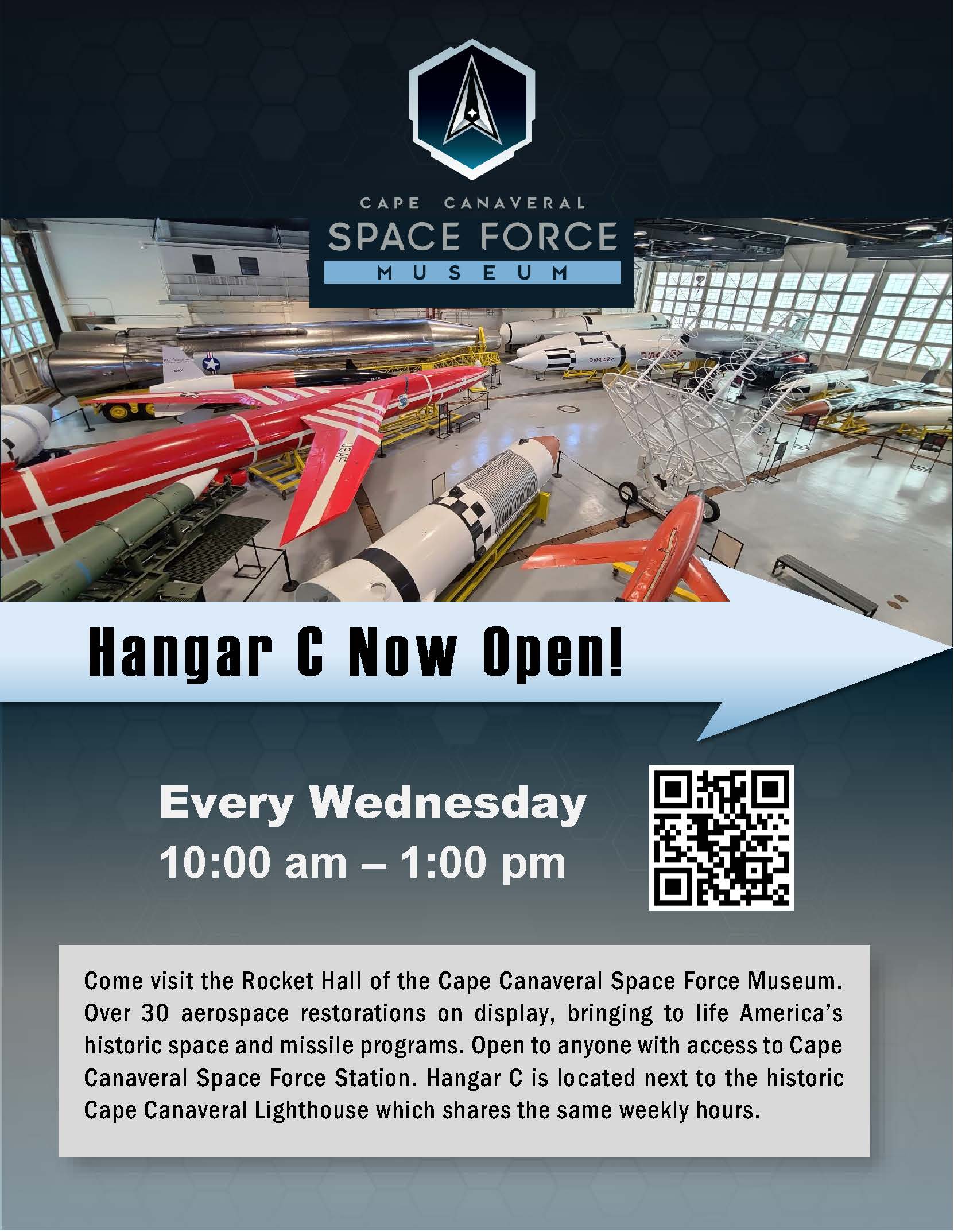
Visit Hangar C
Arcas Launcher, the Big Shot Shroud, and a SUBROC missile, last of their kind known to exist, now on display in Hangar C at Cape Canaveral Space Force Station.
The gift, announced in May 2024, was the largest single private donation in the Foundation's 35-year history. It funded rare Cold War-era artifact restorations and new exhibits at the Museum and the Sands Space History Center. The Arcas Launcher and the Big Shot Shroud are the last of their kind known to exist.
"I am pleased to be able to support the USSF's mission to preserve and promote the rich heritage of space development, education, and exploration," said Jared Isaacman, Commander, Polaris Dawn, in a statement made in a personal capacity at the time of the gift in May 2024.
Blast Off, Inc. of Alabama, which has completed several restorations for the Museum, performed the work. Each piece was disassembled, media-blasted, cleared of active corrosion, treated with corrosion inhibitors, reassembled, and repainted. Interpretive panels for the three artifacts are in production.
"These three pieces spent decades outdoors in the salt air, and two of them cannot be replaced because no others exist," said James W. "Jamie" Draper, Director of the Cape Canaveral Space Force Museum. "Blast Off took each one apart, brought it down to bare metal, stopped the corrosion, and put it back together with as much original material as could be saved, with every step documented. They are back on the floor in Hangar C where they belong, and the Isaacman gift made that possible."
Arcas Launcher. Arcas, the All-purpose Rocket for Collecting Atmospheric Soundings, was a single-stage sounding rocket for high-altitude weather data and small biological payloads. The rocket had no guidance system: wind speed and direction were read just before firing, and the barrel of the cannon-like launcher was tilted to compensate. By the early 1960s, as many as forty-two Arcas rockets a week were launching in the Air Force Meteorological Network. An Arcas rocket is displayed beside the launcher.
Big Shot Shroud. This shroud, or fairing, was a backup for NASA's 1962 Project Echo Big Shot tests, which launched aluminized plastic balloons on Thor missiles from Launch Complex 17 to test deployment methods for Echo's passive communications satellites. Big Shot-2 inflated successfully and rose more than 900 miles above Earth, at the time the largest human-made object placed in space. The tests paved the way for the Echo II satellite in January 1964.
SUBROC. The SUBROC (SUBmarine-ROCket) was a submarine-launched, inertially guided missile developed by the U.S. Navy to engage enemy submarines at long range from a conventional torpedo tube. Fired from a submerged submarine, its solid-propellant motor carried it out of the water and to its target at supersonic speed, where its payload descended to a predetermined depth. A pioneering underwater-to-air-to-underwater weapon system, SUBROC was tested extensively off Florida's east coast in the late 1950s and 1960s.
"Jared's gift was a statement of confidence in this Museum and in the people who care for it, and these restorations show what it is doing," said Raymond Sands, Chairman of the U.S. Space Force Historical Foundation. "Those were dedicated funds, and they did exactly what we said they would. The Foundation's job now is to keep that promise at a larger scale through Legacy of Launch, so the entire Hangar C collection has a permanent, climate-controlled home and work like this lasts for the next generation."
Hangar C is open to the public through the Museum's guided tours. The Sands Space History Center, the Museum's public gateway outside the gate, reopened in June 2025 with new exhibits and offers free admission. Tour information is available at ccspacemuseum.org.
About the U.S. Space Force Historical Foundation, Inc.
Founded in 1989 as the U.S. Air Force Space and Missile Museum Foundation, the U.S. Space Force Historical Foundation, Inc. is a 501(c)(3) nonprofit that supports the Cape Canaveral Space Force Museum through fundraising and development. It funds exhibit development, outreach programming, and expansion planning, and is supported by private donations and gift shop sales.
About the Cape Canaveral Space Force Museum
The Museum collects, restores, preserves, exhibits, and interprets items of historical significance related to United States Air Force and United States Space Force space launch activities, missile airframes, payloads, flight testing, and the history of Cape Canaveral Space Force Station. Its sites include the Museum at Launch Complex 26, Hangar C, and the Sands Space History Center at 100 Space Port Way, Cape Canaveral, FL 32920. Visit ccspacemuseum.org.
About Legacy of Launch
Legacy of Launch is the U.S. Space Force Historical Foundation's campaign to honor more than seventy-five years of American launch at Cape Canaveral and build what comes next: a climate-controlled home for the Hangar C collection, replica rockets on the historic pads, and a public gateway at the Sands Space History Center. Learn more at legacyoflaunch.org.
Editor's note: Mr. Isaacman's statement was made in May 2024 in a personal capacity, prior to public office. It is not a current endorsement by Mr. Isaacman, NASA, or the U.S. Government. The amount of the gift has not been disclosed.
The U.S. Space Force Historical Foundation, Inc. is a private organization. It is not a part of the Department of War or any of its components and has no governmental status.
Jim Thomas
U.S. Space Force Historical Foundation
founders@legacyoflaunch.org
Visit us on social media:
Instagram
Facebook
X
Legal Disclaimer:
EIN Presswire provides this news content "as is" without warranty of any kind. We do not accept any responsibility or liability for the accuracy, content, images, videos, licenses, completeness, legality, or reliability of the information contained in this article. If you have any complaints or copyright issues related to this article, kindly contact the author above.
