

Complete Guide to Binder Mechanism Sizing: O Ring, D Ring and Slant D Ring Dimensions for OEM Projects
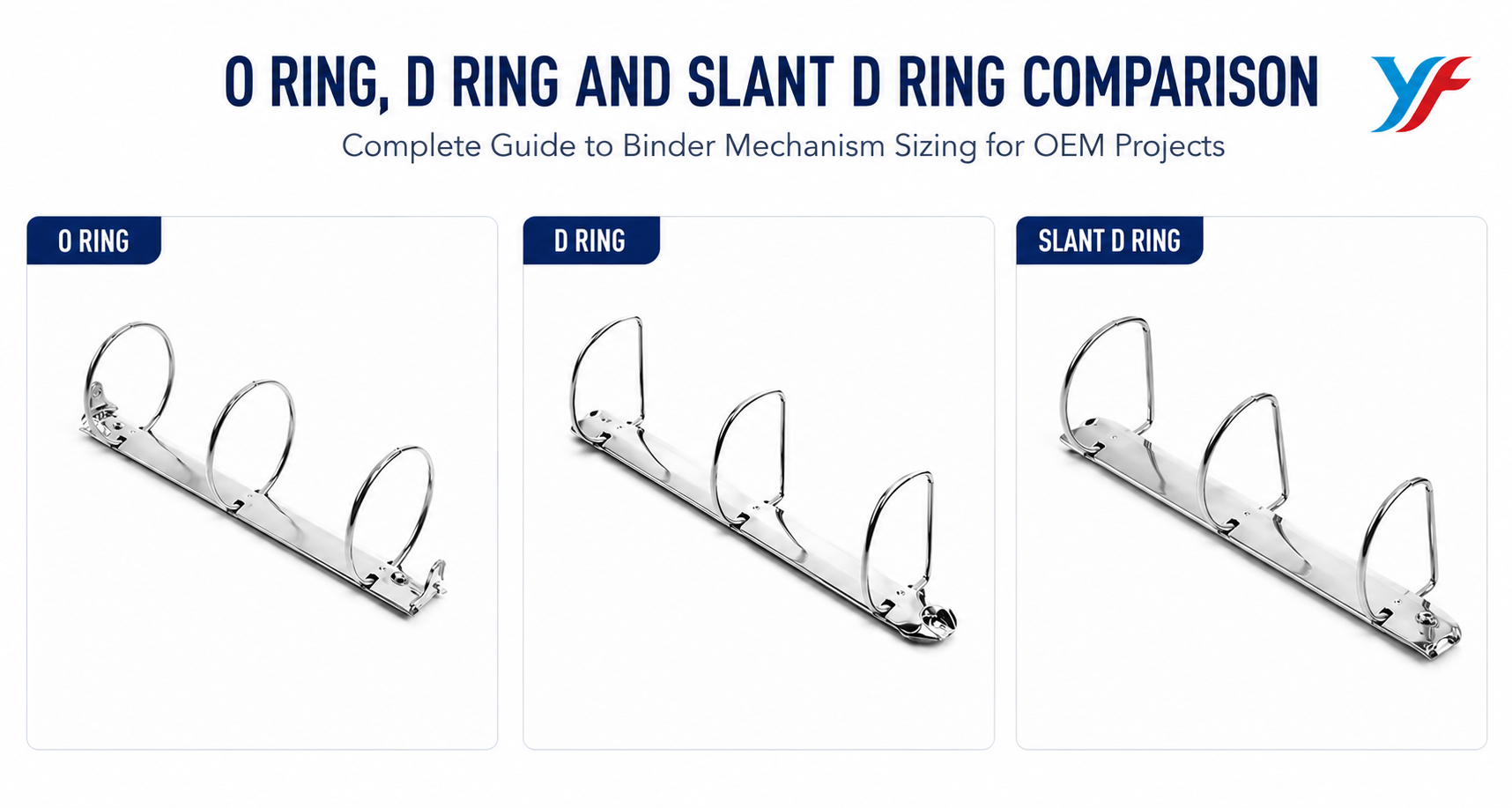
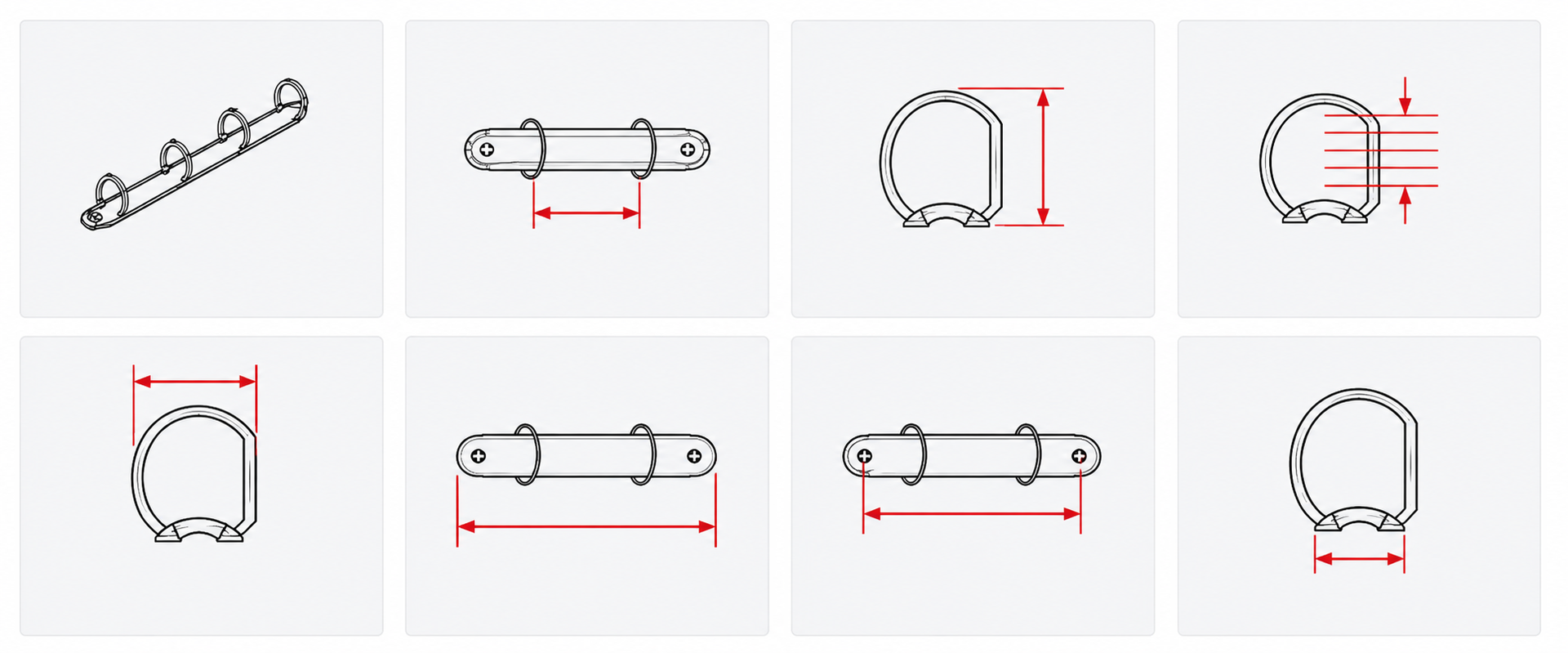
Engineers at Firstly evaluate binder mechanism geometry across five core dimensional parameters: total base plate length, ring center-to-center distances, mounting rivet hole pitch, base plate width, and vertical height clearance. Verifying these geometric dimensions upfront ensures exact alignment with automated cover punching and riveting machinery, streamlining mass production for international stationery brands.
Geometric Nomenclature: Total Length, Ring Distance, and Rivet Hole Spacing
Technical drawing communication begins with standardizing fundamental length and spacing terminology across engineering teams. Total mechanism length defines the overall longitudinal footprint of the steel base plate inside the binder spine. Ring center-to-center distance dictates the precise punching pattern required for paper sheets, separating standard office configurations from compact personal organizer layouts. Mounting hole distance defines the exact center-to-center spacing between the hollow rivets that fasten the mechanism to the binder spine. Mismatches between mounting hole distances and automated riveting heads cause severe cover buckling during final folder assembly.
To prevent costly production errors, Firstly maintains strict dimensional tolerances across all standard and customized length series. Engineers calibrate progressive stamping dies to ensure that ring spacing remains perfectly symmetrical along the mechanism center line. This mechanical precision guarantees that multi-hole punched paper sheets align effortlessly without edge tension or binding friction. Stationery manufacturers receive consistent hardware that integrates smoothly into high-speed automated binder production lines. Clear technical drawings allow overseas procurement managers to confirm every critical dimension before placing volume orders.
Vertical Clearances: Inner Height, Total Height, and Base Width Dynamics
Calculating folder spine thickness requires an accurate understanding of vertical height clearances and base plate widths. Total mechanism height measures the maximum vertical distance from the bottom of the base plate to the highest point of the closed prongs. Inner ring height defines the usable vertical clearance inside the closed loop, directly determining maximum sheet filing capacity. Base plate width provides lateral stability, distributing mechanical clamping forces across the folder spine during opening cycles. Sizing engineers select narrow base widths for slim presentation folders and wider bases for heavy archive binders.
Selecting the appropriate inner height ensures that loose-leaf documents turn freely without binding against the mechanism spine. Firstly offers stepped height tiers that accommodate everything from lightweight business reports to dense reference ledgers. Base plates are formed with reinforced longitudinal ribs that resist bending when folders are filled to maximum document capacity. This structural rigidity prevents prongs from separating under heavy paper loads, preserving neat page alignment. Designers can tailor folder spine widths precisely around Firstly's verified mechanism height profiles.
Ring Shape Architecture: Round, D-Shape, Slant D-Shape, and High-Booster Series
Sizing geometry varies significantly across different ring profile configurations and mechanical actuation styles. Classic round R-shape mechanisms feature symmetrical circular arches, allowing loose-leaf pages to glide smoothly across the top during routine document indexing. Straight-spine D-shape and slant D-shape mechanisms tilt the filing plane to allow paper stacks to rest flat against the binder back cover. This flat stacking alignment prevents document curling and maximizes usable interior storage space in corporate presentation portfolios. Firstly also manufactures modern square Q-shape profiles to support bespoke designer collections and luxury executive folders.
For high-capacity archiving, Firstly manufactures specialized high-booster series that combine raised trigger levers with extended base lengths and expanded ring diameters. These high-booster models feature engineered lever pivots that provide superior mechanical advantage when opening heavy-gauge steel prongs. Buyers can select between manual hand-open mechanisms and trigger-operated systems featuring low-profile trapezoid or raised inclined levers. Smooth plastic buttons can also be integrated to enhance user comfort during repetitive daily document filing. This architectural breadth enables stationery brands to configure cohesive multi-tier product lines.
Engineering Drawings, Physical Templates, and In-House Mold Development
Converting 2D technical drawings into flawless production hardware requires disciplined engineering validation and transparent dimensional documentation. On Firstly’s official enterprise portal, every ring binder mechanism is indexed by a standardized Item No. paired with a complete technical dimensional matrix:
Longitudinal Dimensions: Total Length (base plate footprint) and Hole Distance (mounting rivet center-to-center spacing).
Filing & Spacing Geometry: Ring Distance (center-to-center prong spacing) and Outer Width (transverse profile).
Capacity & Clearance Parameters: Total Height (maximum mechanism height), Inner Height (usable document filing capacity), and Width of Mechanism (base plate seating width).
This transparent technical indexing enables overseas procurement managers and paper converters to cross-reference physical mounting templates against official 2D CAD factory drawings before authorizing mass production. Firstly’s in-house mold design and tooling division utilizes CNC machining centers to produce progressive stamping dies with micro-millimeter tolerance control, rapidly customizing mechanism lengths, non-standard ring spacings, and specialized base widths without third-party markups.
In addition to custom dimensions, Firstly integrates embossed corporate logos and specialized base textures directly into production tooling. In-house surface finishing divisions apply uniform bright nickel plating along with specialized electrophoretic and powder-coated treatments tailored to bespoke stationery collections. Overseas buyers receive verified physical samples and 2D CAD engineering drawings to confirm dimensional fitment before initiating volume manufacturing.
Factory Scale, Brand Partnerships, and Turnkey Assembly Accessories
Fulfilling high-volume OEM procurement contracts requires substantial manufacturing infrastructure and proven supply chain reliability. Firstly operates 15 automatic injection molding machines, 20 high-speed automatic units, and 10 automated assembly lines. The factory maintains a monthly production capacity of around 3 million ring mechanisms and lever arch assemblies. Firstly maintains deep international relationships, including long-term hardware supply partnerships with industry leaders such as Deli, Comix, Bantex, and Leo Paper Group. This extensive manufacturing experience enables Firstly to handle large seasonal procurement orders with predictable production lead times.
To streamline binder manufacturing for international paper converters, Firstly supplies complete sets of matching assembly accessories. Available hardware includes semi-tubular mounting rivets, metal eyelets, finger rings, and strong compressor bars. Multi-stage quality control protocols govern raw material purchasing, stamping inspection, plating, assembly, testing, and packaging. This integrated hardware supply simplifies inventory management and accelerates final product assembly for overseas clients. Global stationery distributors gain predictable lead times and reliable supply chain security for multi-year product lines.
Conclusion
Accurate dimensional planning is the foundation of high-yield binder manufacturing and smooth end-user document handling. By offering a comprehensive sizing matrix of R-shape, D-shape, and slant D-shape mechanisms paired with in-house tooling and technical datasheets, Firstly ensures precise hardware-to-cover fitment and dependable volume supply for global OEM stationery projects.
To download complete binder mechanism dimensional catalogs, request commercial wholesale pricing, or discuss customized OEM tooling, visit the official enterprise portal: http://clipmanufacturer.com/. For direct engineering consultations and physical product samples, contact the global commercial sales division.
FOSHAN FIRSTLY BINDERS CO.,LTD
FOSHAN FIRSTLY BINDERS CO.,LTD
+8675786604386 ext.
email us here
Legal Disclaimer:
EIN Presswire provides this news content "as is" without warranty of any kind. We do not accept any responsibility or liability for the accuracy, content, images, videos, licenses, completeness, legality, or reliability of the information contained in this article. If you have any complaints or copyright issues related to this article, kindly contact the author above.
